
CASE STUDY: Local Search Visibility & Ranking Opportunities for a Sydney Childcare Centre
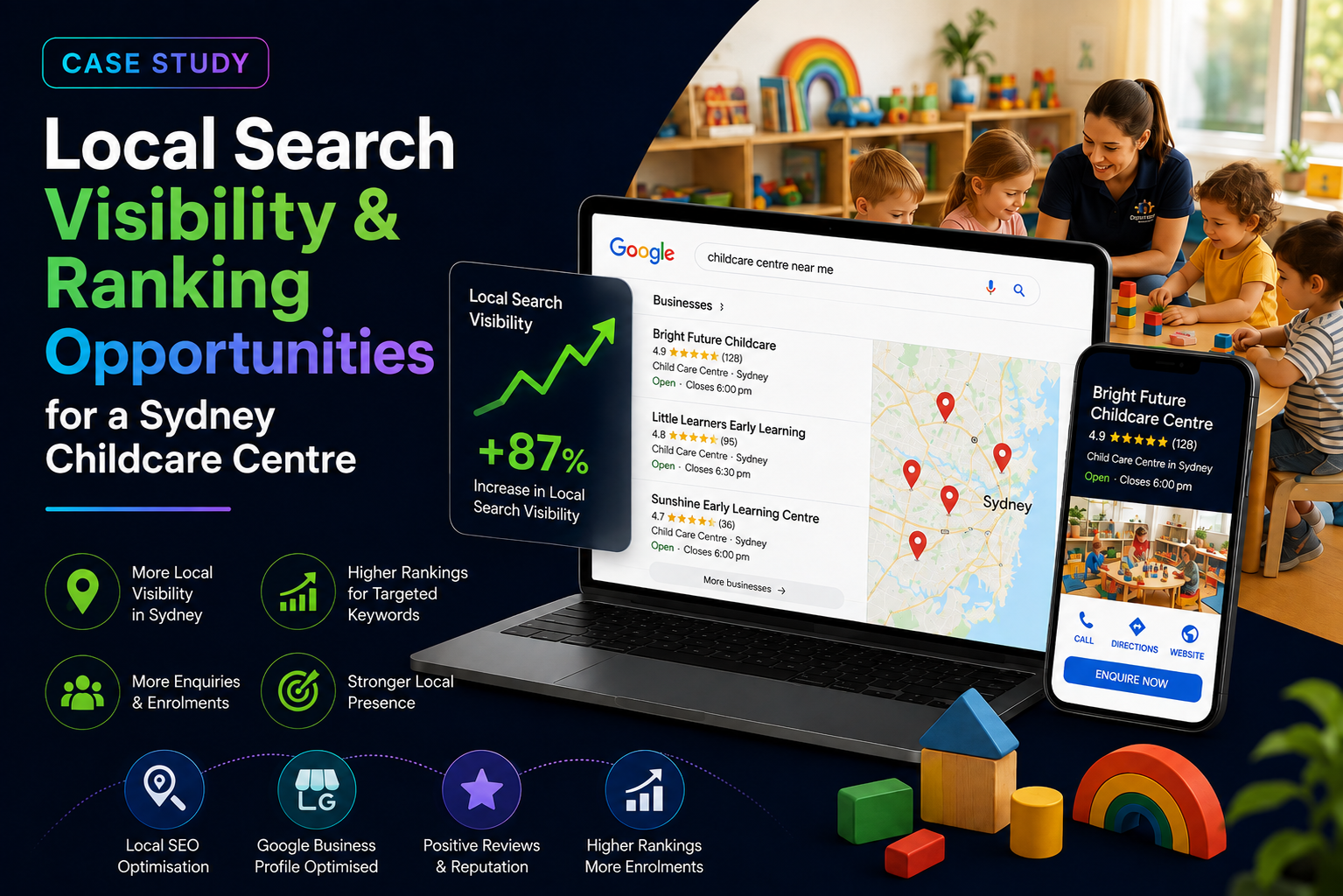
Industry: Early Learning Centre & Childcare
Location: Western Sydney & St George, NSW
Focus area:
Local SEO & Google Search Console ranking analysis
The Client
Picture a multi-campus early learning and preschool provider across Western Sydney and the St George area, doing everything "right" on paper. Every campus had a dedicated location page, but the pages followed very similar structures and targeted overlapping search themes. Parents who already knew the brand could find it in a heartbeat.
The problem? Parents who didn't already know the brand the ones typing "childcare near me" or "preschool [suburb]" into Google at 11pm after a long day often couldn't find it at all. With five near-identical location pages quietly competing against each other, nobody could say with confidence which pages were pulling their weight and which were just along for the ride.
The Challenge
Multi-location SEO isn't just "SEO, but five times." It comes with its own headaches:
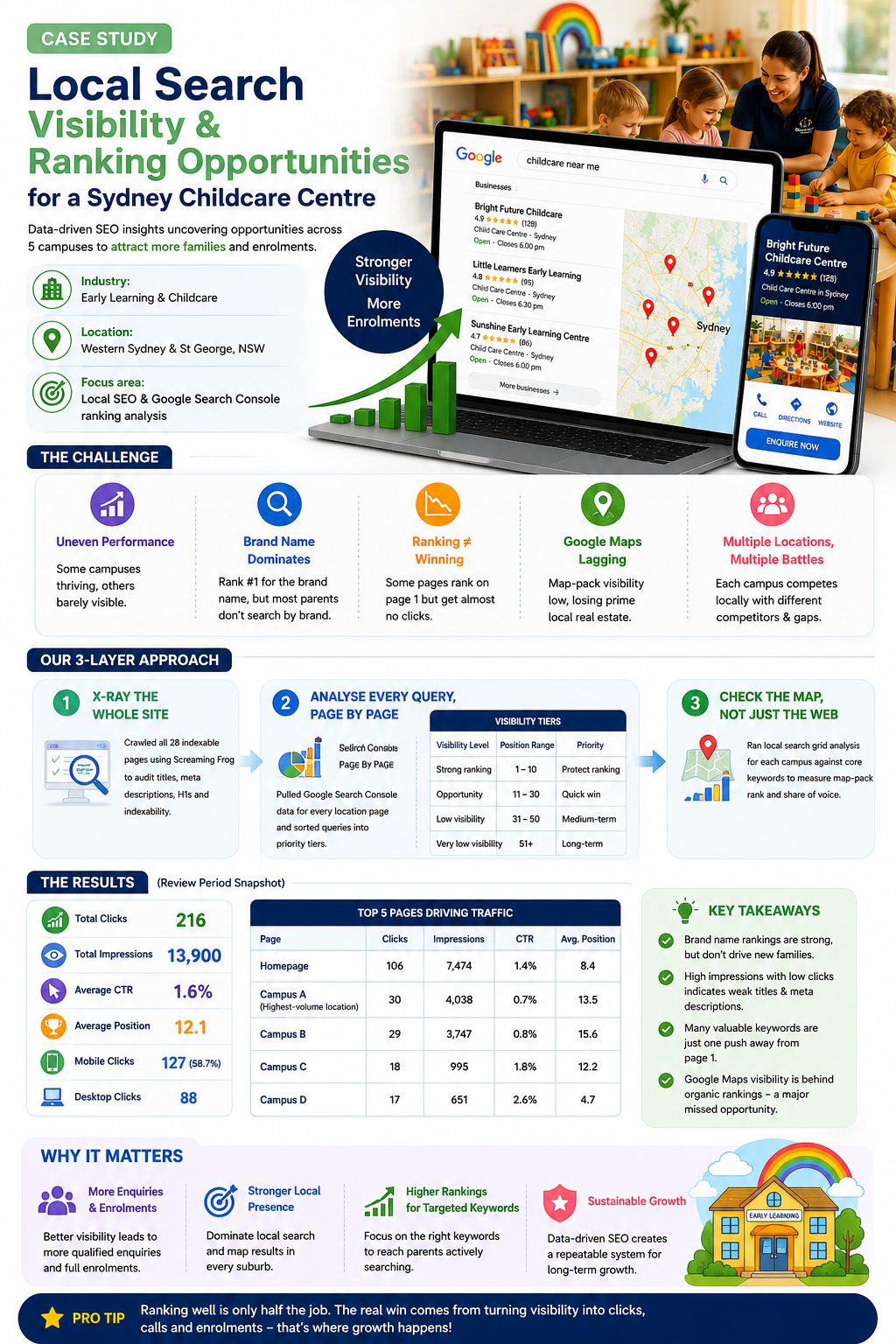
- Some campus pages were performing strongly, while others had very limited organic visibility. Without a page-by-page audit, there was no way to know why one location page was quietly winning while its sibling pages barely registered.
- The brand name was a superstar — everything else was a mystery. Ranking #1 for your own business name feels great, right up until you realise most new families have never heard of you yet, so they're not searching for you by name.
- Some pages were ranking beautifully and getting ignored anyway. Several high-value search terms were showing up on page 1 of Google with healthy impression counts — and next to zero clicks. Ranking isn't the same as winning.
- Google Maps was a black box. Organic blue links are only half the battle for a "near me" search — the map pack often gets the click before anyone scrolls past it.
Our Approach
Rather than eyeballing a single dashboard and calling it a day, we treated this like a proper investigation — three layers deep.
Layer 1: X-ray the whole site.
Using Screaming Frog, we crawled all 28 indexable pages, cataloguing every title tag, meta description, H1, and indexability flag. Think of it as a full health check before touching a single word of copy.
Layer 2: Interrogate every query, page by page.
Site-wide averages are where problems go to hide. So instead, we pulled
Google Search Console data for every individual location page, reviewed performance by clicks and impressions, and classified each query into a priority tier — from "protect it" to "leave it for later":
| Visibility level | Position range | Priority |
|---|---|---|
| Strong ranking | 1-10 | Protect ranking |
| Opportunity | 11-30 | Quick win |
| Low visibility | 31-50 | Medium-term |
| Very low visibility | 51+ | Long-term |
Layer 3: Check the map, not just the web.
Alongside organic rankings, we ran a
local search grid analysis for each campus against core service keywords, including average Local Pack position and local search share of voice. This matters because a parent searching on their phone often sees the map before a single organic result.
The Results
Here's the snapshot from the review period:
| Metric | Value |
|---|---|
| Total clicks | 215 |
| Total impressions | 13,900 |
| Average CTR | 1.6% |
| Average position | 12.1 |
| Mobile clicks | 127 (58.7% of total) |
| Desktop clicks | 88 |
The five pages carrying the load
| Page | Clicks | Impressions | CTR | Avg. Position |
|---|---|---|---|---|
| Homepage | 106 | 7,474 | 1.4% | 8.4 |
| Campus A (highest-volume location) | 30 | 4,038 | 0.7% | 13.5 |
| Campus B | 29 | 3,747 | 0.8% | 15.6 |
| Campus C | 18 | 995 | 1.8% | 12.2 |
| Campus D | 17 | 651 | 2.6% | 4.7 |
But the real story was in the details:
- The brand name was untouchable — and that was the problem. Almost every top-performing query across every page was some version of the business's own name, sitting at an average position of 1–3. Great news for existing fans. Zero help for the families who don't know the name yet.
- One search term ranked on page 1 and still went nowhere. A generic "day care centre [suburb]" query pulled 366 impressions at an average position of 5.5 — a genuinely strong ranking — and earned almost no clicks. That's not a rankings problem. That's a "your listing isn't convincing anyone to click" problem, and it's fixable with a sharper title tag and meta description.
- A stack of quick wins was sitting one push away from page 1. Generic terms like "childcare [suburb]" and "preschool [suburb]" were parked at positions 11–30 across multiple location pages, each pulling hundreds of monthly impressions. These are the cheapest, fastest traffic gains available — no rebuild required, just a nudge.
- Google Maps visibility was quietly lagging behind everything else. Average map-pack rank sat in the high teens (roughly position 16–20), with share of voice as low as 2–10% at some campuses. The organic site was ahead of the Google Business Profile, not the other way around — which is the opposite of what most local businesses expect.
Why It Matters
Running SEO for a multi-location childcare business isn't one campaign. It's several smaller campaigns wearing a trench coat, each fighting its own local battle with its own competitors and its own missed opportunities. Treat it like a single number and you'll miss exactly the details that matter which campus needs a content refresh, which page is ranking but not converting, and which search terms are one small edit away from a page-1 breakthrough.
The single biggest insight here wasn't the average position it was the gap between impressions and clicks. When a page ranks well but receives very few clicks, the search visibility is already there. That makes search-result presentation one of the first areas to review before considering a larger content rebuild or backlink campaign.
Frequently Asked Questions
Why does a multi-location childcare business need separate SEO analysis per campus?
Each location page is effectively fighting its own local battle, with different competitors, different search volume, and different keyword gaps. Look at the site as one average number and you'll miss the campus that's quietly falling behind while another one carries the whole result.
What does it mean when a page ranks well but gets very few clicks?
It often points to a click-through problem rather than a visibility problem. The page is appearing in search, but its title, snippet or overall relevance may not be convincing enough. Reviewing the title tag, meta description and search intent is a sensible first step, although Google may rewrite title links and snippets.
What's the difference between organic rankings and Local Pack (Google Maps) rankings?
Organic rankings are the standard blue-link results, while the Local Pack is the map and three-listing block that often appears above them for local searches. The two are influenced by overlapping but different signals. Organic performance relies heavily on relevance, content quality, technical SEO and authority, while Local Pack visibility is also strongly affected by proximity, Google Business Profile optimisation, reviews and local prominence.
How do you decide which keywords to prioritise first after an audit like this?
We prioritise opportunity keywords already sitting between positions 11 and 30 with meaningful impressions and clear relevance. These terms are closer to page one than lower-ranking keywords, but each still needs to be assessed for search intent, competition and the strength of the existing page.
More Digital Marketing Tips, Tricks & Tools