Multi-Location Businesses: Why One Website Isn't Enough Anymore for Local Search
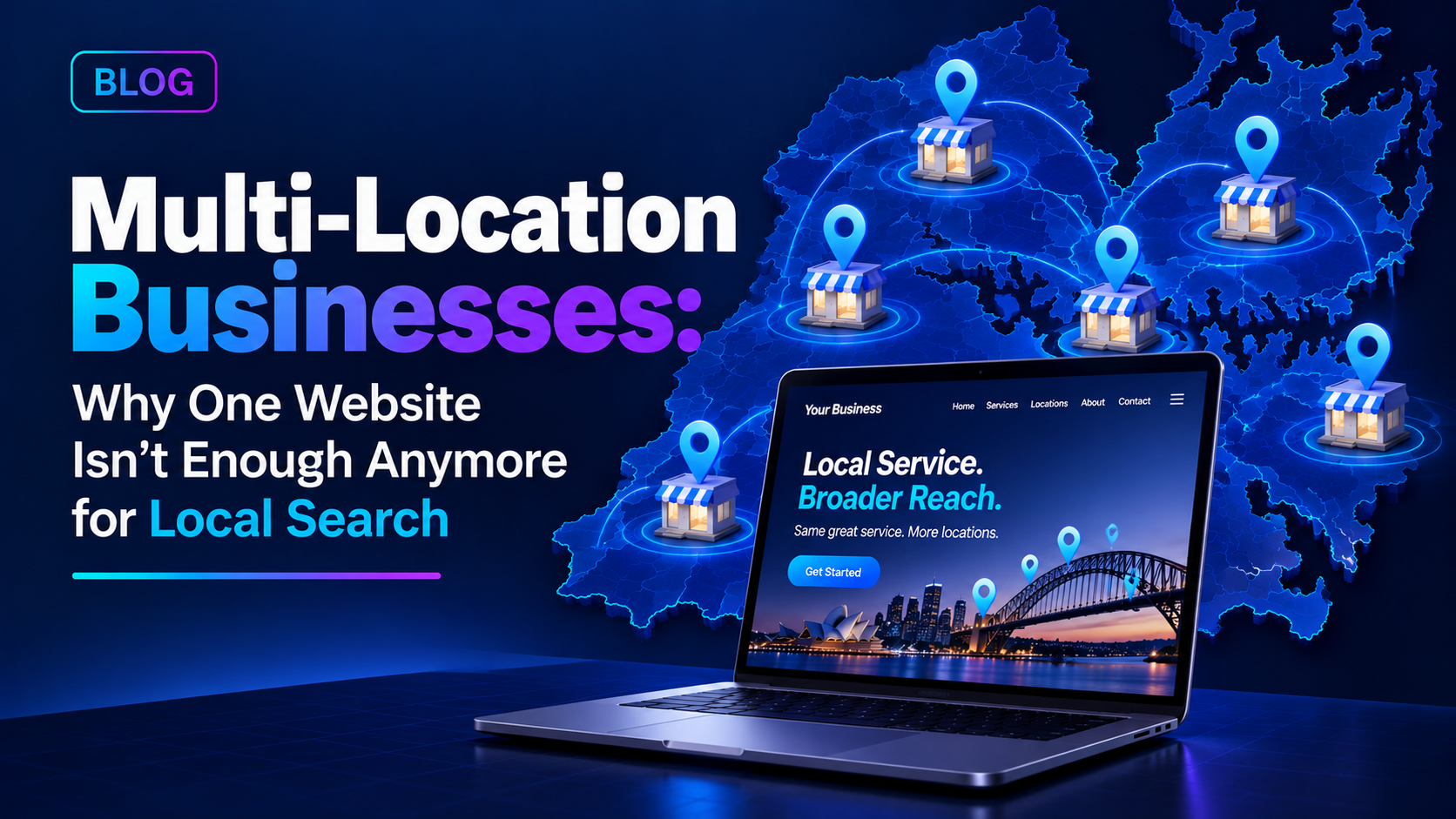
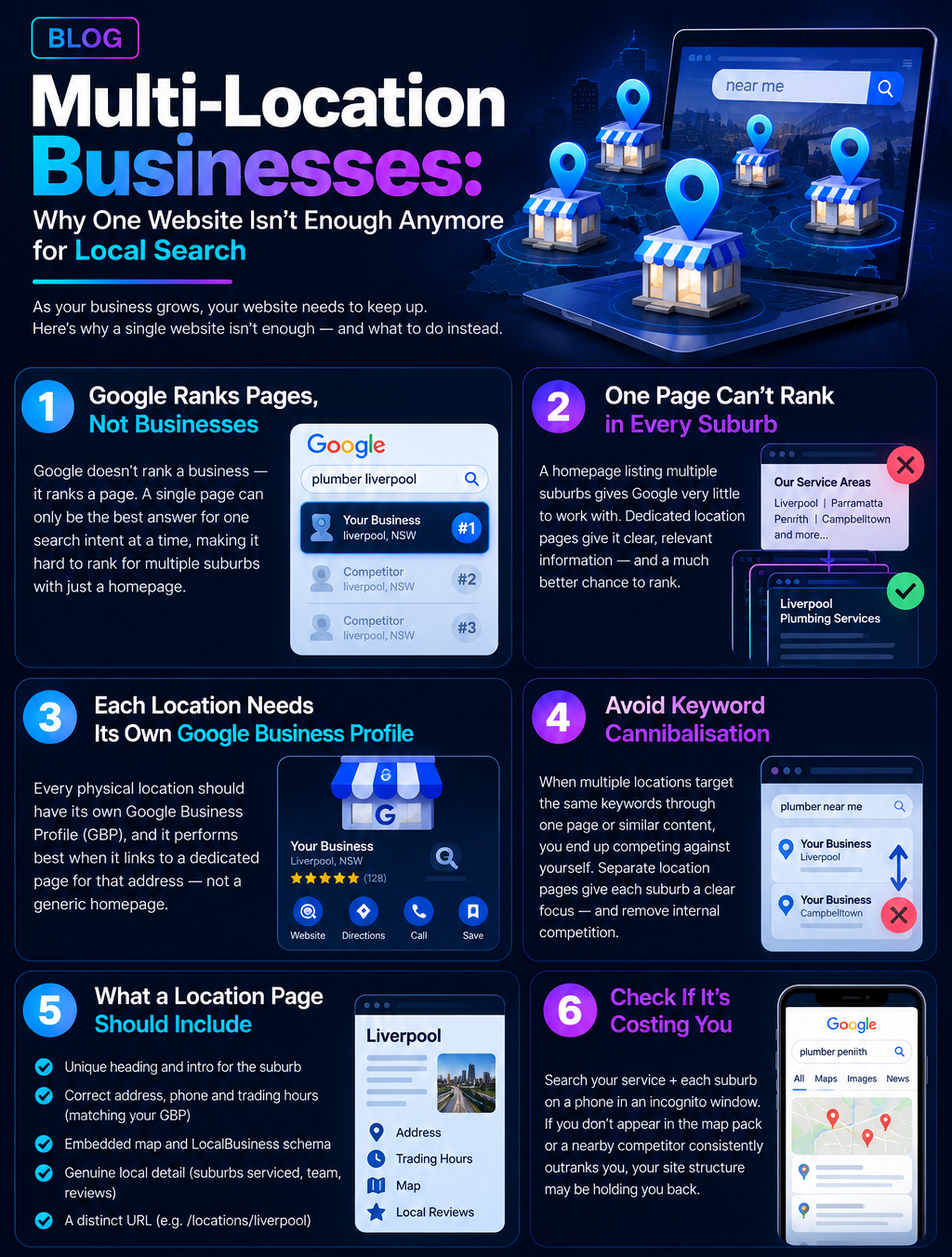
Open a second location, and the instinct is almost always the same: add a line to the homepage, update the "our locations" section, and carry on. It feels efficient. One site, one login, one thing to maintain. It is also one of the fastest ways to quietly cap how much local search traffic either location will ever see, because Google does not rank a business; it ranks a page, and a single page can only be the best answer for one search intent at a time.
This is a different problem to the one most local SEO advice addresses. It is not about writing better content or getting more reviews. It is a structural issue: when two, three, or six locations share one homepage and one generic "service areas" page, you are asking a single URL to outrank specialists in every suburb at once. It rarely can.
Why Google Struggles With One-Page, Multi-Location Sites
When someone searches for your service plus their suburb, Google is trying to match that query to the page that best represents a business operating in that exact area. A homepage listing four suburbs in a sentence gives Google very little to work with. A dedicated page with that suburb in the heading, real local detail, and a linked Google Business Profile for that address gives it everything it needs. Multiply that gap across every location you run, and it compounds. You are not just losing rankings in one market; you are losing them everywhere. The single-page approach forces a generic page to compete against specialists.
There's also a map pack dimension most business owners don't realise until it's pointed out: each physical location needs its own Google Business Profile, and each profile performs best when it links to a page built specifically for that address, not a shared homepage. A GBP that points to generic content sends a weaker relevance signal than one that points to a page clearly written for that suburb, that team, and that service area.
The Cannibalisation Problem Nobody Mentions
There's a second, less obvious cost: keyword cannibalisation between your own locations. If your Liverpool and Campbelltown branches are both trying to rank through the same homepage or near-identical location blurbs, you are effectively competing against yourself. Google can't confidently decide which of your own pages should rank for "[service] near me" in either suburb, so it often ranks neither particularly well. Distinct, properly structured location pages remove that internal competition entirely; each page has one clear job.
What a Location Page Actually Needs
Not every multi-location site needs a full redesign. Most need a properly built page per location, containing:
- A unique heading and intro naming the suburb and what makes that location relevant to it, not a copy-pasted paragraph with the suburb swapped out.
- The correct address, phone number, and trading hours for that location, matching the Google Business Profile exactly, are inconsistent details across pages, which is a common, avoidable ranking drag.
- An embedded map and LocalBusiness schema markup specific to that address.
- Genuine local detail: which suburbs it services, any location-specific team members, and reviews from customers at that branch where possible.
- A distinct URL structure (e.g., /locations/liverpool, /locations/campbelltown) rather than anchor links on a single long page.
None of this requires duplicating your entire site. Your services, pricing philosophy, and brand story can stay centralised. It is specifically the location-facing pages, the ones meant to answer "Is there a [business] near me?" that need to stand alone.
How to Tell If This Is Costing You
A quick way to check: search your service plus each of your location suburbs individually, from a phone, in an incognito window. If your business doesn't appear in the map pack for one or more locations despite operating there, or a competitor with a single nearby address consistently outranks your multi-location homepage, that's the structural gap showing up in real search results. It's a pattern we see often when reviewing sites that expanded operationally faster than they expanded their website; the business grew, but the site structure stayed frozen at one location.
This ties closely into local search optimisation more broadly; it's the same principle behind our suburb-by-suburb approach to Western Sydney SEO, just applied within a single business rather than across a region: generic, one-size-fits-all pages consistently underperform pages built for a specific place.
If you run more than one location and your website hasn't structurally changed since you opened the first one, it's worth an audit before investing further in
SEO or
lead generation campaigns that a thin site structure will only partly convert.
Get in touch and we'll map out what a proper location-page structure would look like for your businesse.
Frequently Asked Questions
Do I need a completely separate website for each location?
No. You need a dedicated page per location within your existing site, with unique content, correct contact details and its own schema markup. Your services, brand and core pages can stay shared and centralised.
Can I just list all my locations on one page instead?
You can, but it typically underperforms. A single page listing several suburbs gives Google far less to match against a specific local search than a page built entirely around one address and area.
What is keyword cannibalisation and why does it matter here?
It's when two of your own pages compete for the same search instead of a competitor's. With multiple locations sharing one homepage, your branches can end up competing against each other, weakening rankings for both instead of strengthening either.
Does each location really need its own Google Business Profile?
Yes, if each has a genuine physical address or service area. Google treats each profile as a separate local entity, and each performs best when it links to a page built specifically for that location rather than a shared homepage.
More Digital Marketing Tips, Tricks & Tools