

How Many Google Reviews Do You Need to Rank Higher?
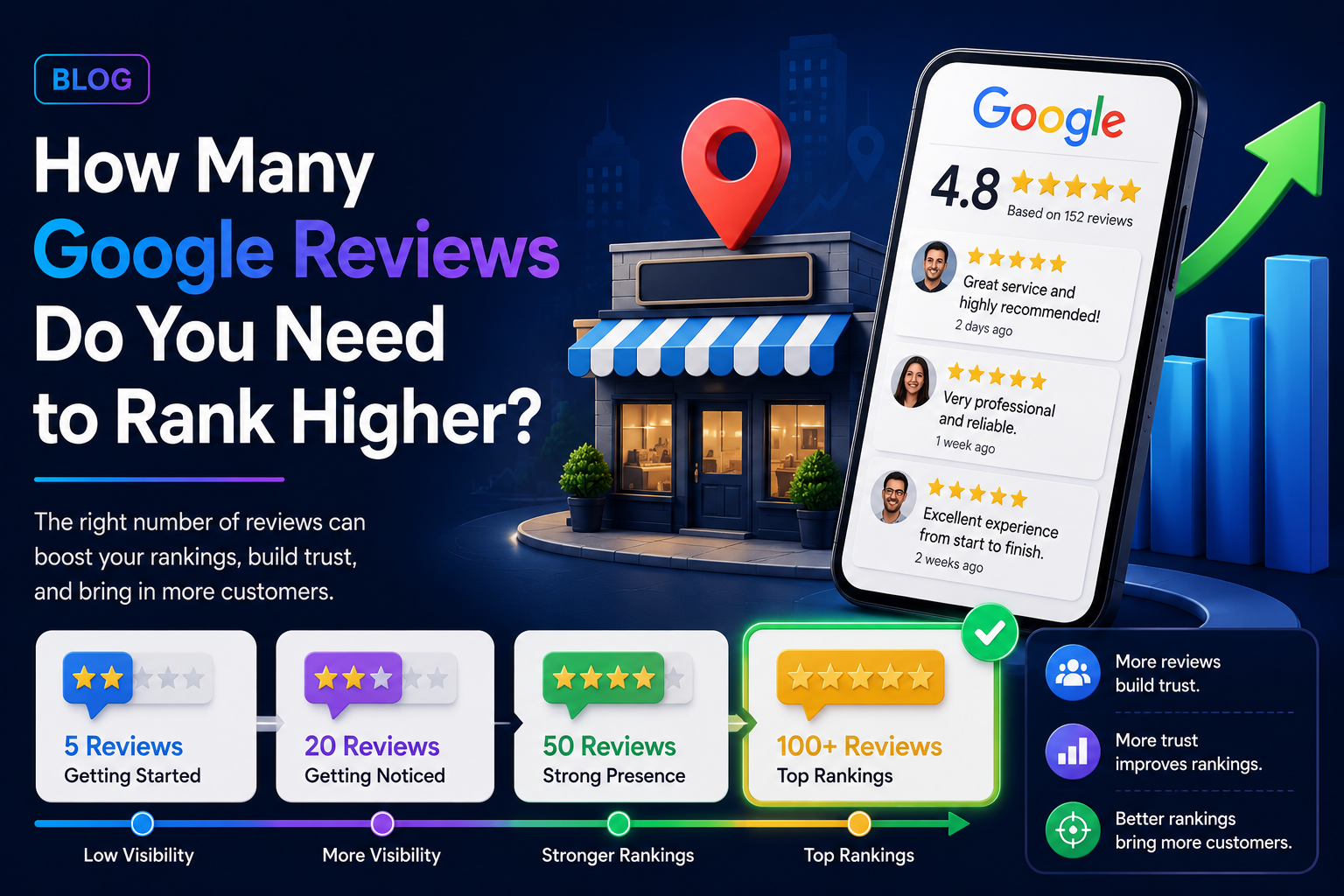
If you've ever typed "how many Google reviews do I need" into a search bar at 11pm, you're not alone. It's one of the most common questions local business owners ask right up there with "why isn't my business showing up on Google Maps." And the honest answer is a little unsatisfying at first: Google has never published a magic threshold. But that doesn't mean reviews don't matter. They matter enormously just not in the way most people think.
Reviews Aren't a Checkbox. They're a Signal
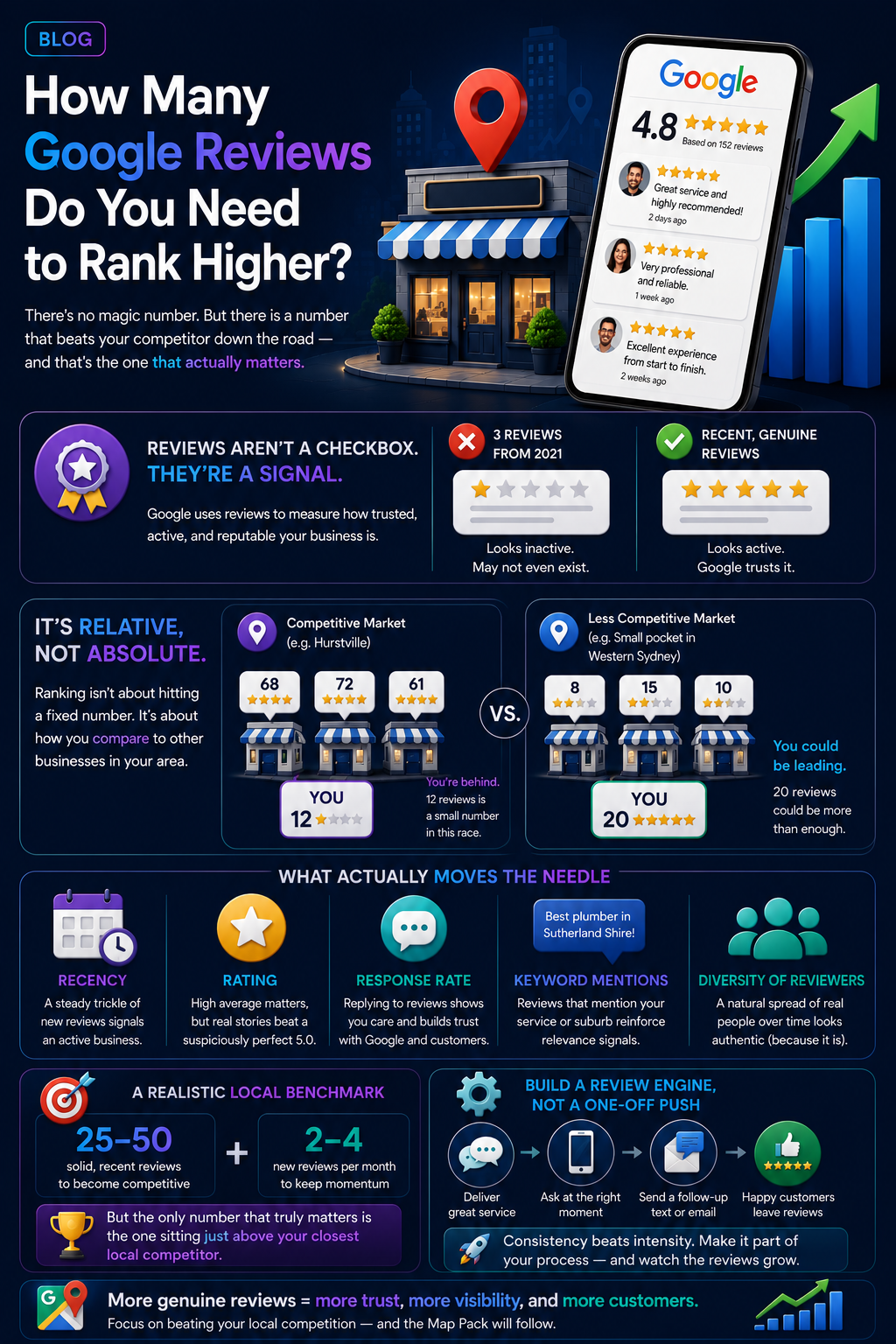
Google's local algorithm leans heavily on three things: relevance, distance, and prominence. Reviews sit squarely inside "prominence" they tell Google how trusted, active, and reputable your business is in the real world. A profile with genuine, recent, detailed reviews reads as a business that's alive and well. A profile with three reviews from 2021 reads as one that might not even still exist.
So the real question isn't "what's the number?" It's "what does my number look like next to theirs?"
It's Relative, Not Absolute
Here's the piece that trips most business owners up: ranking isn't about hitting 50 reviews or 100 reviews in isolation. It's about how you compare to the other businesses fighting for the same Map Pack spot.
If every plumber in Hurstville has 60-plus reviews and you've got 12, you're behind not because 12 is a bad number, but because it's a small number in that specific race. On the other hand, if you're a niche handyman service in a smaller pocket of Western Sydney where competitors are sitting on 8 to 15 reviews, hitting 20 genuine, recent reviews could be more than enough to lead the pack.
That's why chasing a fixed number is the wrong game. Chasing your local competitive set is the right one.
What Actually Moves the Needle
Volume matters, but it's not the whole story. Google's local ranking factors also weigh:
- Recency — a steady trickle of new reviews signals an active business far more than a big pile from years ago
- Rating — a high average matters, but a suspiciously perfect 5.0 with almost no detail can look less trustworthy than a genuine 4.7 with real stories
- Response rate — replying to reviews (especially the tricky ones) shows Google, and customers, that someone's actually running the business
- Keyword mentions — reviews that naturally mention your service or suburb (e.g. "best electrician in Sutherland Shire") reinforce relevance signals Google already looks for elsewhere on your profile
- Diversity of reviewers — a wave of reviews from brand-new, review-only accounts can look manufactured; a natural spread over time looks real, because it is real
A Realistic Local Benchmark
For most service businesses across Sutherland Shire, St George, and Western Sydney, a workable target is somewhere between 25 and 50 solid, recent reviews to become genuinely competitive and then an ongoing rhythm of two to four new reviews a month to keep momentum going. But the only number that truly matters is the one sitting just above your closest local competitor.
Building a Review Engine, Not a One-Off Push
The businesses that win long-term don't run a single "ask everyone for a review" campaign and stop. They build review requests into the normal rhythm of the job: a follow-up text after a service call, a QR code on an invoice, or a quick ask at the moment a customer says, "Thanks, that was great." Consistency beats intensity every time.
Ready to Start Climbing the Map Pack?
Reviews are one piece of a bigger local SEO puzzle — alongside profile accuracy, citations, and local content. At Leads 4 Business, our
Local Search Optimisation service builds all of these together into one strategy tailored to your local competition.
Get in touch and let's find out exactly how many reviews you need to win your patch.
Frequently Asked Questions
Is it bad to have a lower star rating than my competitors?
A 4.6 with 80 reviews often outperforms a 5.0 with 6 reviews. Volume and authenticity carry more weight than a near-perfect average.
Can I ask customers directly for reviews?
Yes — and you should. Google actively encourages business owners to invite customers to leave feedback, as long as it's not incentivised or gated to only positive reviewers.
Do negative reviews hurt my ranking?
Occasional negative reviews are normal and can even boost trust when handled well. What matters more is your overall pattern and how you respond.
How quickly will more reviews improve my ranking?
It varies, but many businesses notice movement in the Map Pack within six to ten weeks of a consistent, genuine review-generation effort.
More Digital Marketing Tips, Tricks & Tools